Consular Processing: Document Collection and Submission
Date of Information: 04/02/2026
Check back soon; we update these materials frequently.
Introduction
Most consular processing delays are not caused by the government—they are caused by incomplete, inconsistent, or improperly submitted documents. This page explains what you need to gather, how to submit it, and how your documents are actually reviewed so your case can move forward without avoidable delays.
Important:
These guidelines are primarily designed for immigrant visa cases, which have the most stringent documentation requirements. Non-immigrant visa applicants can use this as a general reference, but their requirements are typically more limited.
Purpose of Document Submission and Review During Consular Processing
Most people assume consular processing is about filling out forms and uploading documents. That is only partially true.
In reality, this stage of the process is about building a complete, internally consistent evidentiary record that allows the government to approve your case without needing to ask questions. If your submission is clear, complete, and consistent, your case moves efficiently. If it is not, it will be delayed—sometimes repeatedly.
What This Stage of the Process Is Actually About
Consular processing is the second phase of an immigration case. By this point:
A petition has already been approved (in most cases)
The government has recognized a qualifying relationship or eligibility category
Now, the focus shifts to three things:
Identity — Who you are
Eligibility — Whether you qualify under the approved petition
Admissibility — Whether you are legally allowed to enter the United States
Every document you submit fits into one of these categories. If something is missing, unclear, or inconsistent in any of them, the process stops.
How the Document Submission Process Works
For most immigrant visa cases, document collection and submission happens through the National Visa Center (NVC) using the CEAC system.
The process generally follows this sequence:
Case is created at NVC
Fees are paid
Applicant completes the required forms
Civil and financial documents are uploaded
NVC reviews the submission
Case is marked “documentarily complete”
Case is scheduled for interview
This page focuses on Steps 4–6, where most delays occur.
What NVC Is Actually Reviewing
NVC is not evaluating your case on the merits in the same way a judge would. Instead, it is acting as a quality control gatekeeper. The review focuses on:
Whether all required documents are present
Whether those documents meet technical requirements
Whether the documents are internally consistent
Whether anything is missing, unclear, or incorrect
If the answer to any of those is “no,” the case is returned for correction. Each correction cycle adds time.
The Role of Consistency (This Matters More Than Clients Expect)
Applicants tend to focus on whether they have documents.
The government focuses on whether those documents match each other.
Common issues include:
Different spellings of names across documents
Conflicting dates of birth
Inconsistent marriage or divorce timelines
Variations in place-of-birth information
These do not automatically result in denial—but they:
Trigger delays
Require explanation
Create avoidable risk
Before submission, every case should be reviewed for internal consistency.
The Checklist: What You Should Be Gathering
The following documents form the core of most consular processing cases. Not every case will require every item, but most will require many of them.
Identity and Civil Documents
These establish who you are and your legal relationships:
Passport (biographic page)
Birth certificate (correct version for your country)
Marriage certificate (if applicable)
Divorce or annulment records (all prior marriages)
Death certificates (if applicable)
National ID card (if applicable)
Purpose:
To prove identity and legal family relationships recognized under U.S. law.
Police and Criminal Records
Police certificates from required countries
Court records for any arrest or charge
Final disposition records
Purpose:
To allow the government to evaluate admissibility based on criminal history.
Immigration History
Prior U.S. visas
Entry/exit records
Prior immigration filings
Removal or deportation records
Purpose:
To assess prior compliance with U.S. immigration law and identify any bars or waivers required.
Financial Sponsorship (If Required)
Form I-864
Tax returns or IRS transcripts
Proof of income
Joint sponsor documentation (if needed)
Purpose:
To demonstrate that the applicant will not become a public charge.
Military Records (If Applicable)
Service records
Discharge documents
Purpose:
To evaluate background and admissibility issues. (For more information on admissibility issues related to national security, please refer to our Research Guide section on those topics, including the CIL Guide Terrorism Related Inadmissibility Grounds.)
Primary vs. Secondary Evidence
The system expects primary evidence—official civil documents. If those documents are not available:
You may use secondary evidence
But you must explain why the primary document does not exist
In many cases, you must provide an official statement confirming non-availability
Submitting substitutes without explanation is one of the fastest ways to delay a case.
Understanding the State Department Reciprocity Tables: Why the “Right Document” Depends on Your Country
The U.S. Department of State maintains what are called “reciprocity tables” for every country. These tables define:
What civil documents exist in that country
Which versions are considered valid for U.S. immigration purposes
Which issuing authorities are acceptable
Whether certain documents are unavailable or unreliable
This is the standard the government uses—not local custom, not what a document looks like, and not what someone tells you informally.
A Common Question
You might be asking: “What if my country doesn’t produce or use the same kinds of documents as the United States?” That is a fair question—and the system accounts for it.
The U.S. government recognizes that documentary practices vary widely across countries. That is exactly why the reciprocity tables exist: to tell you what the U.S. will accept from your specific country of origin. In some cases, the tables will also indicate that:
A normally required document does not exist in your country
A document is considered unreliable or unavailable
A different or substitute document should be provided instead
How to Upload Documents Through CEAC
Most applicants will submit documents electronically.
The process is straightforward—but execution matters.
Basic Steps
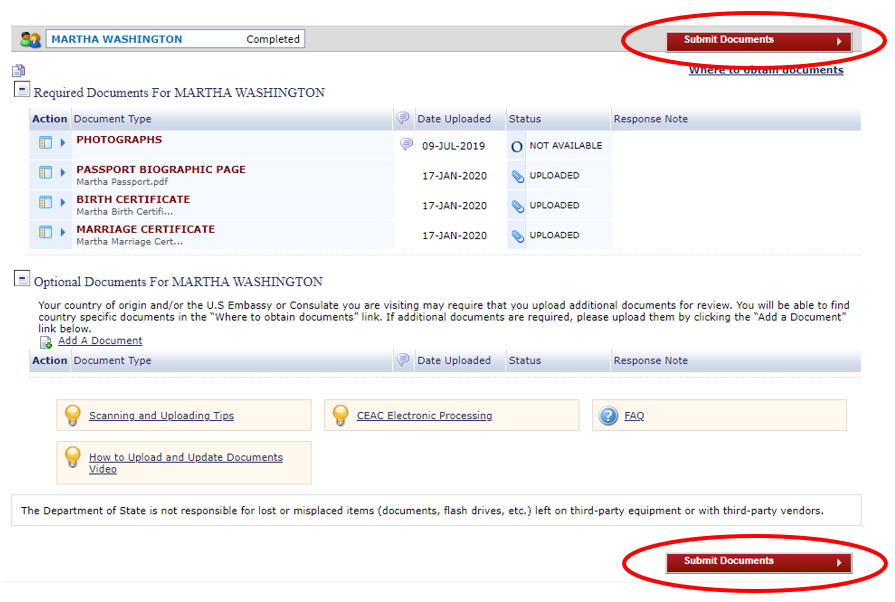
Log into CEAC
Select the correct applicant
Upload the correct document under the correct category
Confirm the file is complete and readable
What Actually Causes Problems
Blurry or low-quality scans
Missing pages
Cropped seals or signatures
Incorrect document uploaded under the wrong category
If a document cannot be reviewed quickly and clearly, it will be rejected.
Cases That Are Not Processed Electronically
Most immigrant visa cases now move through CEAC, but not all of them do. In a smaller number of cases, the National Visa Center will instruct applicants to submit documents by physical mail or by email instead. The critical point is simple: do not choose the submission method yourself. Follow the method the National Visa Center specifically assigns to your case. The State Department expressly warns that sending documents by mail when you were not told to do so will delay processing, and the same is true for email submission when email has not been authorized.
If NVC instructs you to mail documents, you should submit all required items in one package at the same time. The State Department warns that cases may be significantly delayed if documents are submitted piecemeal rather than together. A proper mail submission should generally include the document cover sheet from the NVC welcome letter, the required financial forms and supporting evidence, and photocopies of civil documents with any required translations.
Just as important, applicants should not mail original passports or original civil documents such as birth or marriage certificates to NVC. The State Department instructs applicants to send photocopies only and to keep the originals for the visa interview. That rule applies regardless of the submission method.
If NVC instructs you to submit documents by email, the State Department directs applicants to scan and save their financial forms, civil documents, and translations as PDF files and send them as attachments to the designated NVC email address. The case number should appear in the subject line, and each PDF must be no larger than 5 MB. If more than one case number is involved, each case should be handled in a separate email rather than combined together.
There are a few practical rules worth emphasizing here. First, if you have documents for more than one case number, do not combine them in a single envelope or a single submission. Each case must be handled separately. Second, NVC does not accept documents on CDs, memory cards, or other electronic media. Third, if you need to contact NVC in writing, the State Department says you should use the Public Inquiry Form rather than sending a separate written inquiry by other means, because using the wrong channel will slow the response.
Practical Advice
If your case is not eligible for standard CEAC electronic processing, that does not necessarily mean something is wrong. It usually just means that NVC has assigned your case to a different submission track. The main risk in these cases is not denial. The real risk is delay caused by failing to follow the assigned method exactly. For that reason, the safest approach is to submit everything in the format NVC specifies, send complete packages rather than fragments, keep originals in your possession unless explicitly told otherwise, and avoid improvising.
A Practical Reassurance About Mistakes
It is important to understand the difference between delay and denial. Submitting the wrong document, uploading a poor-quality scan, or making a technical mistake in the document submission process will usually not result in a visa denial. Instead, what typically happens is:
The document is rejected or flagged
You are asked to correct or replace it
Your case is returned to the review queue
The consequence is delay—not denial. However, that does not mean these issues are harmless. Each correction cycle can:
Add weeks or months to processing time
Push your case back in line for review
Create frustration and uncertainty
In contrast, denials are typically based on substantive legal issues, such as:
Inadmissibility (criminal, immigration, or fraud-related issues)
Failure to establish eligibility
Failure to provide required evidence after being given the opportunity to do so
The Bottom Line
You do not need to fear that a technical mistake will automatically destroy your case. But you should treat the document submission process seriously, because: Sloppy submissions do not usually kill cases—but they routinely slow them down. The goal is not perfection—it is to avoid unnecessary cycles of correction that delay an otherwise approvable case.
Efficiency: How to Avoid Delays
Most delays in consular processing are not caused by complicated legal issues. They are caused by avoidable mistakes in document preparation and submission.
The National Visa Center is not trying to interpret your case—it is checking whether your submission is complete, compliant, and internally consistent. If anything is unclear, missing, or inconsistent, your case is sent back for correction.
Each correction cycle can add weeks or months.
What Efficient Submission Actually Looks Like
An efficient submission has three characteristics:
Complete — All required documents are included
Clear — Every document is legible and easy to review
Consistent — All documents align with each other
If any one of these is missing, delays follow.
1. Gather Documents Early
Some documents take time to obtain, especially:
Police certificates from multiple countries
Civil documents from foreign registries
Replacement or corrected records
Waiting until the last minute almost guarantees delay.
2. Verify Country-Specific Requirements
Not all documents that appear valid are accepted.
You must confirm:
The correct version of each civil document
The correct issuing authority
Any required annotations or supporting records
Using the wrong document—even if it looks official—will result in rejection.
3. Submit Complete Documents (Not Fragments)
Every document must be:
Fully scanned
Complete (all pages included)
Clearly visible (including seals, stamps, and signatures)
Partial submissions are one of the most common reasons documents are rejected.
4. Standardize Names, Dates, and Key Information
Before submission, review all documents side-by-side.
Look for:
Different spellings of names
Different date formats or conflicting dates
Variations in place-of-birth information
If inconsistencies exist:
Do not ignore them
Provide a written explanation
Provide supporting documentation if available
Unexplained inconsistencies are one of the fastest ways to trigger delays.
5. Upload Documents Correctly in CEAC
Even correct documents can cause delays if uploaded incorrectly.
Make sure:
Each document is uploaded under the correct category
Files are oriented correctly (not sideways or upside down)
Scans are clear and readable
If the reviewer cannot immediately understand what they are looking at, the document may be rejected.
6. Submit a Complete Package—Not Piecemeal
Uploading documents gradually or correcting issues one at a time slows the process.
Instead:
Prepare everything first
Review the entire file for completeness and consistency
Submit all documents together
The goal is to avoid multiple review cycles.
7. Monitor Your Case and Respond Quickly
After submission:
Check CEAC regularly for updates
Respond promptly to any requests for correction
Delays in responding can extend processing time or, in extreme cases, lead to case termination.
The Practical Standard
The goal is simple: Give the reviewer no reason to ask for anything else. If your submission answers every question clearly, your case moves forward. If it raises questions, the process stops until those questions are resolved.
Need Help Preparing Your Submission?
We help clients identify missing documents, resolve inconsistencies, and prepare complete, review-ready submissions for consular processing.
Frequently Asked Questions
1. What does it mean when my case is “documentarily complete”?
A case is considered documentarily complete when the National Visa Center determines that all required forms and supporting documents have been submitted in acceptable form and there are no obvious deficiencies or inconsistencies. This does not mean your visa has been approved or that an interview has been scheduled. It simply means your case is ready to be forwarded to the consulate when an appointment becomes available.
2. Why was my document rejected even though it is a real, official document?
The issue is not whether a document is “official” in your home country, but whether it meets U.S. immigration standards. The State Department relies on country-specific reciprocity tables that define which documents are acceptable, which authorities may issue them, and what information they must contain. A document can be perfectly valid locally and still be rejected if it does not meet those specific requirements.
3. How long does NVC document review take?
There is no fixed timeline for NVC review. Processing times depend on overall workload and, more importantly, whether your submission is complete the first time. Cases that require corrections are routinely delayed because they must be re-entered into the review queue after each update.
4. What happens if I upload the wrong document or make a mistake?
In most cases, a mistake in document submission will not result in a denial. Instead, the document will be rejected or flagged, and you will be asked to correct the issue. Your case will then return to the review queue. The practical consequence is delay, not denial, but those delays can add up quickly if multiple corrections are required.
5. Can I submit documents one at a time as I receive them?
While the system allows documents to be uploaded incrementally, doing so often slows the process. Submitting documents piecemeal increases the likelihood of multiple review cycles and repeated delays. It is generally more efficient to prepare a complete, internally consistent set of documents and submit them together.
6. What if my documents contain inconsistencies in names or dates?
Inconsistencies should be addressed directly, not ignored. If different documents contain variations in names, dates, or other key details, you should provide a clear explanation and, where possible, supporting documentation. Unexplained discrepancies are one of the most common reasons cases are delayed during document review.
7. What if I cannot obtain a required document?
If you are unable to obtain a document, the first step is to consult the State Department reciprocity tables to determine whether the document is considered unavailable in your country. If it is, you may need to provide secondary evidence along with an explanation or proof of non-availability. Submitting substitute documents without explanation is likely to result in rejection and delay.
8. Do I need to submit original documents to NVC?
NVC generally requires scanned copies of documents rather than originals. However, you must retain original or certified copies for later stages of the process. Even if your uploads are accepted, you may still be required to produce original documents later, and failure to do so can cause additional delays.
9. What makes a document acceptable for CEAC upload?
An acceptable document is one that is complete, legible, properly oriented, and uploaded under the correct category. The standard is practical: a reviewer must be able to understand the document quickly and without ambiguity. If a document is difficult to read or appears incomplete, it is likely to be rejected.
10. What happens if my case sits too long without action?
If a case remains inactive for an extended period—generally one year—it may be terminated, and previously paid fees may be lost. Maintaining regular communication and responding promptly to any requests from NVC is essential to avoid this outcome.
11. Is NVC deciding whether I will be approved for a visa?
No. NVC is not making a final decision on your eligibility for a visa. Its role is to review your submission for completeness, compliance, and consistency, and to ensure that your case is ready for consular processing. The final decision is made later by a consular officer.
12. What is the most common reason cases are delayed at this stage?
Most delays at this stage are caused by document issues rather than legal ones. Missing documents, incorrect document types, poor-quality scans, and inconsistencies across records are the most common problems. These are largely avoidable with careful preparation.
13. Should I be concerned if my case is returned for correction?
A case being returned for correction is common and does not mean your case will be denied. It typically indicates that something in the submission was incomplete, unclear, or inconsistent. However, repeated corrections can significantly extend processing time, so it is best to address issues thoroughly the first time.
14. Do I need an attorney for the document submission stage?
Not every case requires legal representation at this stage, but having an attorney can reduce the risk of delay. An experienced attorney can identify deficiencies before submission, ensure compliance with country-specific requirements, and help resolve inconsistencies that might otherwise slow the process.
Charles International Law’s research guides are always free, but if you find them helpful, please consider a donation or gratuity.
