
Economic Sanctions and Mass Deportations:
How to Navigate Sanctions under the Trading with the Enemy Act in Remittances to Family in Cuba
Date of Information: 10/15/2026
Check back soon; we update these materials frequently.

Introduction
When a Cuban national returns home—through removal, voluntary departure, or another decision to leave the United States—the family may face unexpected questions: How can the person lawfully take savings to Cuba, and how can relatives provide financial support afterward? Immigration arrangements, economic sanctions, and border currency declarations follow separate rules, and meeting one does not necessarily meet the others.
Sending money to relatives overseas and physically carrying savings across the border can trigger different requirements. Both methods may implicate economic sanctions, while transporting cash also raises separate customs and currency-reporting obligations. Depending on the circumstances, one method may be authorized while another requires additional permission.
Minor differences in the facts can distinguish a lawful transaction from conduct carrying substantial civil or criminal penalties. Moreover, the rules are not always intuitive: ownership, immigration status, the source and purpose of the funds, and the parties involved can all affect the analysis.
This guide addresses two separate questions. First, do U.S. economic sanctions authorize the proposed transfer or use of money in Cuba? Second, if someone physically carries that money across the border, what declarations and reporting requirements apply?
Cuba Policy Context: Attempted Normalization, Reversals, and Cost to American Families
Today’s rules reflect competing political approaches to Cuba. President Obama pursued diplomatic normalization and eased restrictions; President Biden later relaxed some Trump-era limits, including restrictions on family remittances. President Trump repeatedly moved toward greater economic pressure and reversed parts of those openings. The following reporting traces those changes:
Obama’s opening—December 2014: Reuters: U.S., Cuba to restore diplomatic relations after 50 years. Reports on the restoration initiative, planned easing of restrictions, and Obama’s request that Congress lift the embargo. Stabroek News
Trump’s partial reversal—June 2017: Reuters: Trump rolls back parts of Obama Cuba policy. Describes tighter travel and business restrictions, while explaining that some diplomatic changes remained intact. Stabroek News
Biden’s easing—May 2022: Reuters: U.S. revises Cuba policy, eases restrictions on remittances, travel. Explains the announced removal of the family-remittance cap and expanded travel and family-reunification opportunities, while noting that Biden stopped short of fully restoring Obama’s approach. KSL.com
Trump’s renewed reversal—January 2025: Reuters: Trump revokes Biden removal of Cuba from U.S. state sponsors of terrorism list. Covers Trump’s reversal of Biden’s final effort to ease sanctions associated with that designation. investing.com
Our perspective: Economic isolation and mass deportation reflect Trump’s preference for coercive pressure, even though the two sets of regulations operate differently. Their practical intersection can leave families confronting two burdens at once: arranging a relative’s departure and navigating restrictions on the money needed to support that person afterward.
The historical distinction matters: Trump did not create the Cuba embargo, and neither Obama nor Biden abolished it. The documented policy dispute concerns whether to ease restrictions and pursue engagement or preserve and intensify economic pressure; the embargo’s statutory framework also limits what a president can change alone. Stabroek News
Part I: Economic Sanctions—When Is Moving Money to Cuba Authorized?
The Trading with the Enemy Act and Cuba sanctions
The Trading with the Enemy Act supplies part of the legal foundation for the Cuban Assets Control Regulations, 31 C.F.R. part 515, administered by the Treasury Department’s Office of Foreign Assets Control, or OFAC. These regulations restrict financial transactions involving Cuba while authorizing specified activities through licenses.
Additional sanctions operate alongside that framework. The Cuba Sanctions Regulations, 31 C.F.R. part 516, implement Executive Order 14404, while General License 1 preserves transactions otherwise authorized or exempt under the Cuban Assets Control Regulations against the additional prohibitions imposed by that order. Families must still satisfy the conditions of the underlying authorization.
These rules can apply to electronic transfers, cash gifts, and money physically carried into Cuba. A government-arranged departure or an immigration court’s departure order should not be treated as permission to conduct every accompanying financial transaction.
General licenses and specific licenses
A general license authorizes a category of transactions for anyone meeting its conditions. When a general license clearly applies, the person ordinarily may proceed without applying to OFAC for individual approval.
A specific license is written authorization issued in response to an application concerning a particular transaction. OFAC also accepts requests for interpretive guidance when someone needs an explanation of how an existing authorization applies to particular facts.
Are personal remittances to family in Cuba legal?
Yes, qualifying family remittances remain authorized under 31 C.F.R. § 515.570(a). Adults subject to U.S. jurisdiction may send money to Cuban nationals who qualify as close relatives, provided the transaction satisfies the regulation’s conditions.
The money generally cannot come from a blocked source. The recipient also cannot be a prohibited Cuban government official, a prohibited Communist Party member, or a close relative of either. Ordinary family remittances must be distinguished from the separately regulated payments associated with emigrating from Cuba to the United States.
Does the $1,000 quarterly cap still apply?
No. OFAC removed the former $1,000 quarterly cap on family remittances effective June 9, 2022.
The former cap came from a rule adopted during the first Trump administration, published as Cuban Assets Control Regulations, 84 Fed. Reg. 47,121 (Sept. 9, 2019), and effective October 9, 2019. It amended 31 C.F.R. § 515.570(a) to limit each sender’s family remittances to any one Cuban national to $1,000 during any consecutive three-month period. Treasury described the broader sanctions package as an effort to financially isolate the Cuban government, restrict its access to hard currency, and pressure it over repression and support for the Maduro government in Venezuela, while preserving support for the Cuban people and independent private businesses. The cap therefore restricted otherwise authorized family support as part of a broader foreign-policy strategy.
The current family-remittance authorization contains no dollar ceiling, although its other conditions remain applicable. OFAC’s Federal Register explanation states:
“OFAC is amending § 515.570(a) to remove the $1,000 quarterly limit on remittances to Cuban nationals who are close relatives.”
The citation is Cuban Assets Control Regulations, 87 Fed. Reg. 35,088, 35,089 (June 9, 2022). The operative amendment appears at page 35,091.
Section 515.570(e) still contains two specified, one-time authorizations of up to $1,000 each for expenses associated with emigrating from Cuba to the United States. Those provisions do not create a quarterly cap on ordinary family support and do not govern someone returning to Cuba.
Who qualifies as a close relative?
Section 515.570 incorporates the definition in 31 C.F.R. § 515.339. It recognizes relationships by blood, marriage, or adoption and applies a test based on being within three generations of the person or a shared ancestor.
The definition extends beyond parents and children. The regulation expressly treats a mother’s first cousin and a husband’s great-grandson as close relatives, while expressly excluding a daughter’s father-in-law. Readers should consult the definition and its examples when a relationship is uncertain.
Can someone send money to a nonrelative?
Section 515.570(b) separately authorizes qualifying donative remittances to Cuban nationals. An eligible recipient therefore does not necessarily have to be related to the sender.
This provision concerns gifts and contains conditions concerning the source, recipient, purpose, and individual sender’s age. A payment for goods or services, or an investment, requires its own analysis rather than simply being labeled a personal remittance.
Restrictions on banks and payment intermediaries
An authorized purpose and eligible recipient do not make every payment route permissible. Section 515.570(j) excludes transactions involving the collection, forwarding, or receipt of remittances through entities on the Cuba Restricted List.
OFAC permits qualifying banks and U.S.-registered money transmitters to process authorized remittances, including digital payments. Families should confirm that the proposed provider and its Cuban payment partners can lawfully handle the transaction; a provider’s own compliance policies may also limit its services.
Bringing spending money during a family visit
A temporary visit to a qualifying Cuban relative may fall under the family-visits general license, § 515.561(a). That license incorporates authorized travel expenses, including ordinary living expenses under § 515.560(c)(2).
For example, an adult daughter visiting her Cuban father may generally bring $1,000 of her own money for food and ordinary expenses during the qualifying visit without applying for a specific OFAC license. She must observe restrictions on prohibited transactions and accommodations and retain records supporting the authorized travel.
If she gives her father some of her money, that gift may separately qualify as a family remittance. Section 515.560(c)(4) permits authorized travelers to carry qualifying remittances, subject to the applicable conditions.
Taking personal savings when returning permanently
A person returning permanently to Cuba with accumulated savings presents a different legal question. Owning the money does not, by itself, establish authorization to export it to Cuba.
Under § 515.560(e), a blocked Cuban national permanently resident in Cuba who is departing the United States may carry specified funds:
Currency originally brought into the United States and registered with CBP upon entry.
Authorized remittances received during the person’s stay in the United States.
Documented salary or compensation authorized under § 515.571(a)(5).
This provision contains no general $10,000 ceiling. However, its compensation category incorporates an authorization tied to qualifying nonimmigrant status or travel authorization; it should not automatically be treated as covering every asylum seeker’s accumulated wages.
Section 515.505 also matters. Certain Cuban nationals residing in the United States—including qualifying individuals with pending asylum applications—are treated as unblocked nationals, but that status ends when they resume domicile or permanent residence in Cuba.
The person’s immigration history, residence, source of funds, and intended transaction therefore require review. Withdrawing money before departure does not, standing alone, resolve whether carrying it into Cuba for permanent resettlement is authorized.
Obtaining guidance or permission before departure
Start by identifying the exact transaction and gathering immigration documents, account statements, pay records, remittance records, ownership information, and departure arrangements. Counsel can then determine whether an existing general license covers the proposed activity.
When coverage is uncertain, an interpretive-guidance request can ask OFAC how the regulations apply to those facts. When additional authorization is necessary, a specific-license application under 31 C.F.R. § 501.801(b) should identify the parties, describe the proposed transaction, and include supporting records. Both types of requests are available through the OFAC Licensing Portal.
Where appropriate, the requested authorization should cover withdrawal, any necessary unblocking, and physical transportation of a specified amount for personal resettlement expenses. Filing an application does not authorize those activities, and OFAC does not guarantee a decision before a scheduled departure.
Part II: Carrying Cash to Cuba—Customs Declarations and Currency Reporting
Reporting cash is separate from obtaining OFAC authorization
Physical transportation of money raises an additional question: Must the traveler report the amount to border authorities? In the United States, the principal report is FinCEN Form 105, also called a Currency and Monetary Instruments Report, or CMIR.
A CMIR is similar to, but ultimately distinct from, a bank’s Currency Transaction Report, or CTR. A withdrawal reported by a bank does not replace the traveler’s separate obligation to report qualifying international transportation.
When is FinCEN Form 105 required?
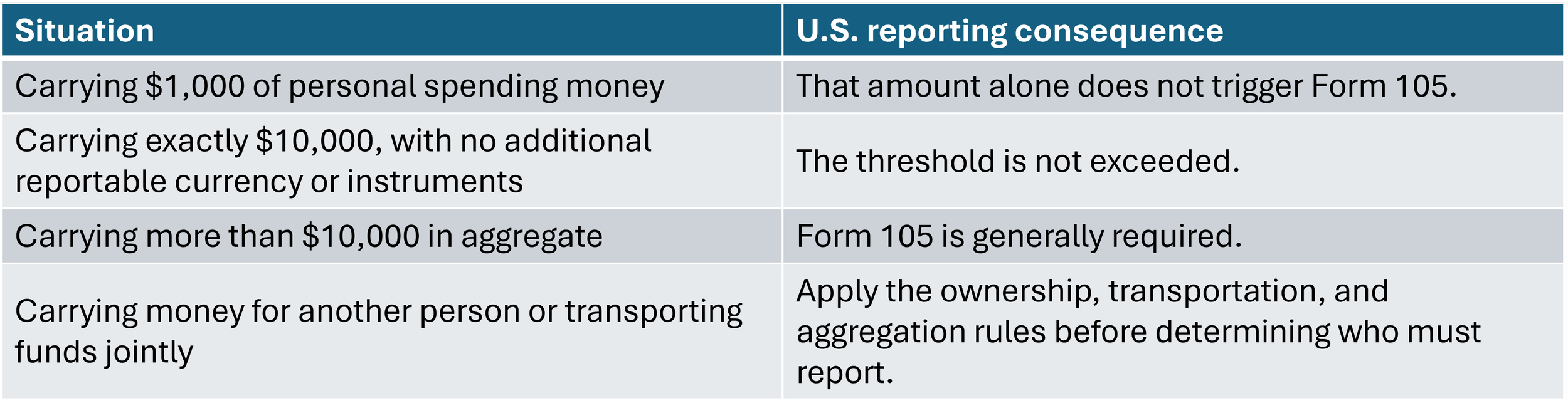
Under 31 C.F.R. § 1010.340, transporting an aggregate amount exceeding $10,000 in currency or reportable monetary instruments into or out of the United States generally requires a report. The calculation includes qualifying foreign currency and monetary instruments, rather than only U.S. dollar bills.
The threshold is a reporting trigger, not a general ceiling on the amount someone may carry. Separate restrictions—including OFAC sanctions—may nevertheless prohibit a particular transportation.s Paragraph 1
How and when to file
Travelers can submit Form 105 through the electronic reporting system. The reporting regulations require filing at departure, subject to CBP’s filing procedures, so travelers should follow the current instructions and retain the confirmation for presentation to CBP.
A Form 105 confirmation is not an OFAC license. It documents the reported transportation but does not authorize an otherwise prohibited export of currency.
“Can’t I just have each of my family members carry $9,999?”
There is no automatic family exemption allowing a larger sum to be divided among several people. If a parent distributes the parent’s money among adult children, the analysis must account for transportation conducted through others or on another person’s behalf.
Each adult carrying independently owned savings presents different facts. However, the parties must accurately disclose ownership and any joint transportation arrangement rather than assume that separate pockets establish separate transactions.
Deliberately arranging the transportation to evade reporting can itself be unlawful. Under 31 U.S.C. § 5324(c), structuring or assisting in structuring an international transportation of monetary instruments for that purpose is prohibited, even when the underlying funds were lawfully earned.
What must be declared upon arrival in Cuba?
Cuba has its own currency-declaration requirements. Published Cuban consular guidance requires declaration of currency exceeding US$5,000 or its equivalent upon entry.
Consequently, carrying $1,000 does not, by that amount alone, exceed either country’s stated currency-reporting threshold. Carrying $10,000 may require a Cuban declaration even when the U.S. threshold is not exceeded, and travelers should verify the applicable arrival instructions before departure.
What records should travelers carry?
Useful records depend on the transaction. A visiting relative with ordinary spending money needs different documentation from someone permanently relocating with substantial accumulated savings.
Depending on the circumstances, relevant records may include:
Bank statements and withdrawal receipts showing ownership and the movement of funds.
Pay statements or other evidence establishing the underlying source.
Records of gifts or authorized remittances.
Travel records supporting the family visit.
Any applicable OFAC specific license or written interpretive guidance.
Required U.S. and Cuban currency declarations.
A withdrawal receipt establishes where the traveler obtained the physical cash, but it may not explain how the money was originally acquired. Likewise, carrying a printed regulation does not establish that the traveler satisfies its conditions.
What can happen if the reporting rules are violated?
Failing to file a required currency report, omitting funds, or providing false information can lead to seizure, forfeiture, and civil or criminal penalties. Intentionally concealing money to evade reporting or structuring its transportation may create additional exposure.
Carrying a substantial amount of cash does not establish a violation by itself. Accurate reporting, lawful authorization, and records explaining ownership and source address different parts of the legal analysis.
How Charles International Law can help
Charles International Law can evaluate the interaction between immigration status, economic sanctions, family support, and international currency reporting. Our review can identify applicable authorizations, assess supporting records, and prepare an OFAC guidance request or license application when needed.
Before permanent departure or a substantial transfer, obtain advice addressing the actual source, ownership, amount, intended use, and transportation of the funds. A family member’s temporary visit and another person’s permanent return may require different answers, even when they travel on the same flight.
Principal legal authorities and official resources
31 C.F.R. § 515.570: Family and other authorized remittances
87 Fed. Reg. 35,088 (June 9, 2022): Removal of the quarterly family-remittance cap
31 C.F.R. § 515.339: Definition of close relative
31 C.F.R. § 515.561: Authorized family visits
31 C.F.R. § 515.560: Travel expenses, carried remittances, and departing Cuban nationals’ currency
31 C.F.R. § 515.505: Unblocked status of qualifying Cuban nationals
31 C.F.R. § 1010.340: International currency-reporting requirements
31 U.S.C. § 5324: Prohibited structuring
OFAC licensing and interpretive guidance: Requests for individual guidance or authorization
FinCEN Form 105 electronic filing: Reporting physical transportation of currency
Frequently Asked Questions
Economic Sanctions and Family Support
1. Is it legal to send money to relatives in Cuba?
Yes, qualifying family remittances are authorized under 31 C.F.R. § 515.570(a). The sender must be at least 18 and subject to U.S. jurisdiction, and the transaction must satisfy restrictions concerning the source of funds, recipient, purpose, and payment route. Certain Cuban government officials, Communist Party members, and their close relatives are excluded from this authorization.
2. Is there still a $1,000 quarterly limit on family remittances?
No. OFAC removed that limit effective June 9, 2022, and the current family-remittance provision contains no dollar ceiling. The amendment appears in Cuban Assets Control Regulations, 87 Fed. Reg. 35,088, 35,089, 35,091 (June 9, 2022); the official Federal Register PDF documents the change.
3. Who qualifies as a “close relative”?
The definition in 31 C.F.R. § 515.339 includes qualifying relationships by blood, marriage, or adoption within its three-generation test. It extends beyond immediate family: the regulation expressly includes a mother’s first cousin and a husband’s great-grandson, while excluding a daughter’s father-in-law.
4. Can I send a gift to someone in Cuba who is not related to me?
Yes, an eligible recipient may receive a qualifying donative remittance under § 515.570(b). The gift must meet that provision’s conditions, and calling a commercial payment or investment a “gift” does not make it an authorized personal remittance.
5. Do I have to apply to OFAC before sending an authorized remittance?
No application is ordinarily required when a general license covers the transaction. General licenses are self-executing, meaning that people who satisfy their conditions may rely on them without obtaining individual OFAC approval; applicable recordkeeping and reporting obligations still apply.
6. Can I use any bank, app, or transfer service?
No. An authorized recipient and purpose do not make every payment route permissible. OFAC allows qualifying financial institutions and U.S.-registered money transmitters to process authorized remittances, but the remittance authorizations exclude collection, forwarding, or receipt involving entities on the Cuba Restricted List.
7. Can I bring my own spending money when visiting family in Cuba?
Generally, yes, when the visit qualifies under the family-visits general license. Sections 515.561(a) and 515.560(c)(2) authorize qualifying family visits and ordinary living expenses during authorized travel, so bringing personal money for food and other ordinary expenses does not ordinarily require a specific OFAC license. Restrictions on prohibited transactions and accommodations remain applicable.
8. Can I give my father or another relative cash during the visit?
Yes, if the gift qualifies as an authorized family remittance. Section 515.560(c)(4) permits authorized travelers to carry remittances covered by § 515.570, but the recipient, source of funds, and other conditions must still satisfy the applicable authorization.
9. Can a Cuban asylum seeker take accumulated savings when returning permanently?
That requires an individual analysis. Section 515.560(e) authorizes specified categories of currency carried by departing Cuban nationals covered by that provision, while § 515.505 addresses unblocked status and its termination upon resuming domicile or permanent residence in Cuba. A pending asylum application, employment authorization, or bank withdrawal does not by itself resolve every requirement for transporting accumulated savings to Cuba.
10. What if we cannot determine whether a general license applies?
OFAC accepts requests for interpretive guidance addressing how its rules apply to particular facts. If the transaction requires authorization beyond an existing general license, the person may apply for a specific license through the OFAC Licensing Portal; submitting the application does not authorize the proposed transaction.
Carrying Cash and Border Reporting
11. How much cash can I carry without filing FinCEN Form 105?
The U.S. reporting requirement generally applies when the aggregate amount of currency and reportable monetary instruments exceeds $10,000. Exactly $10,000 does not exceed that threshold, but additional cash—including foreign currency—counts, and transportation through or on behalf of others may require aggregation.
12. Does carrying more than $10,000 automatically make the trip illegal?
No. The $10,000 threshold triggers a reporting requirement rather than a general prohibition on transporting money. A traveler may nevertheless need separate OFAC authorization for taking the funds to Cuba, regardless of whether Form 105 is filed.
13. Is FinCEN Form 105 the same as a bank’s CTR?
No. Form 105 reports international transportation of currency and monetary instruments, while a CTR concerns specified transactions involving financial institutions. A bank’s report of a cash withdrawal does not replace a required Form 105 for the subsequent international transportation.
14. Can several adult children each carry $9,999?
They cannot avoid reporting by dividing someone’s money into smaller amounts. Independently owned savings present different facts, but transportation conducted jointly or on another person’s behalf can require aggregation, and deliberately structuring the transportation to evade reporting can violate 31 U.S.C. § 5324(c).
15. Does filing Form 105 give me permission to take money to Cuba?
No. Form 105 satisfies a reporting obligation when properly completed; it does not supply an OFAC license. A traveler must separately establish that the proposed transportation and use of funds comply with applicable sanctions.
16. Does Cuba require its own cash declaration?
Yes. Published Cuban consular guidance requires declaration of currency exceeding US$5,000 or its equivalent upon entry. That threshold differs from the U.S. threshold, so a traveler may need to declare money in Cuba even when no U.S. Form 105 is required.
17. Does carrying $1,000 of personal spending money require a currency report?
That amount alone does not exceed either the U.S. reporting threshold or Cuba’s published currency-declaration threshold. The traveler must still comply with ordinary entry requirements, answer customs questions accurately, and satisfy the applicable OFAC authorization for the trip and expenditures.
18. What happens if I fail to report money when required?
Failure to file a required report or providing false information can lead to seizure, forfeiture, and civil or criminal penalties. Deliberate concealment or structuring to evade reporting can create additional exposure, even when the money was lawfully earned.
19. What documents should I bring?
Bring records appropriate to the source, ownership, and purpose of the money, such as bank statements, pay records, remittance records, and any required currency declarations. If relying on an OFAC specific license or written guidance, carry it as well; a withdrawal receipt alone may show where the physical cash came from without establishing its underlying source or authorization.
Charles International Law’s research guides are always free, but if you find them helpful, please consider a donation or gratuity.
