
What to Expect From Charles International Law During Your Defensive Asylum Case
Date of Information: 05/11/2026
Check back soon; we update these materials frequently.

Introduction
Facing removal proceedings in Immigration Court can be one of the most stressful experiences of a person’s life. Unlike the affirmative asylum process before USCIS, a defensive asylum case takes place in an adversarial courtroom setting where the Department of Homeland Security is actively seeking your removal from the United States. Immigration Court proceedings are formal legal proceedings with strict procedural rules, filing deadlines, evidentiary requirements, and potentially life-changing consequences.
At Charles International Law, we approach defensive asylum representation with the seriousness that these cases deserve. Our role is not merely to complete forms or appear at hearings. We build legal cases designed to withstand scrutiny from Immigration Judges, trial attorneys for Immigration and Customs Enforcement, and, when necessary, appellate courts.
This page explains what you should realistically expect from us — and what we will expect from you — during the course of a defensive asylum case.
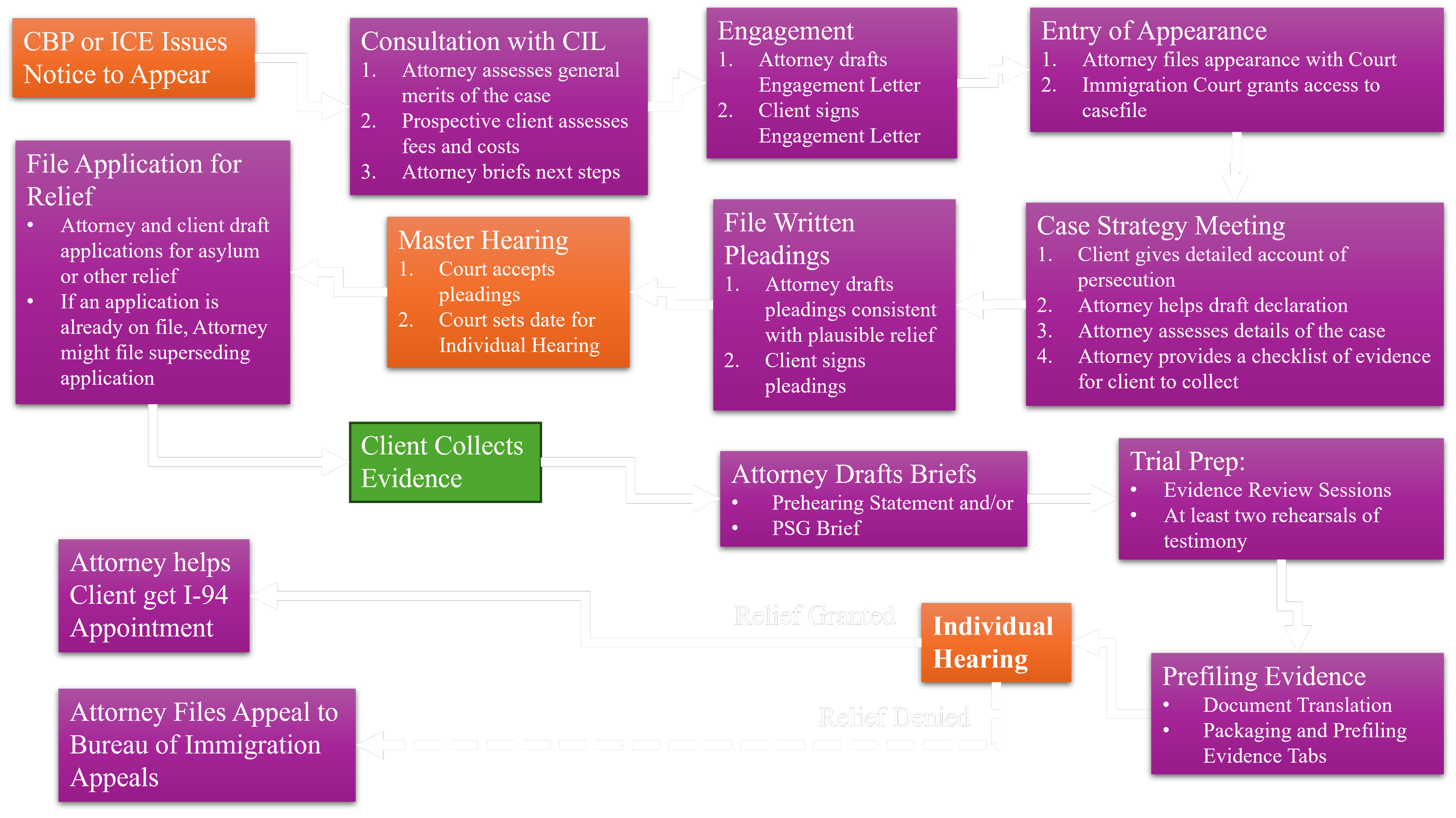
Defense Asylum & Removal Defense Case Lifecycle
The diagram below reflects a fairly typical defensive asylum and removal defense case lifecycle within Charles International Law. No two immigration cases are identical, and every client’s procedural posture, immigration history, factual background, and evidentiary situation is different.
Some cases begin immediately after apprehension at the border. Others involve years of prior immigration proceedings, prior asylum filings, criminal allegations, family petitions, reinstatement issues, or appeals.
Some clients are detained. Others are not.
Some cases require extensive motion practice or appellate litigation. Others proceed more directly toward an individual merits hearing.
Accordingly, the exact sequence, timing, and structure of representation often changes depending on the unique procedural and factual requirements of the case. Nevertheless, the process outlined below represents the general operating model that Charles International Law typically uses in defensive asylum and removal defense matters. In most cases, clients can expect a process broadly similar to the one depicted here, including detailed factual development, evidence collection, strategic case assessment, written pleadings and briefing, extensive hearing preparation, and, where necessary, appellate review.
Defensive Asylum/Removal Defense is Litigation
Many asylum seekers understandably assume that asylum cases primarily involve telling their story to the government. In reality, a defensive asylum case is adversarial litigation. There is a judge and two sides to the conflict: you and Charles International Law, and a trained government attorney representing the U.S. Department of Homeland Security. The government attorney is not your friend: his or her mission is to deport you. The Immigration Judge is evaluating both your credibility and whether your case satisfies the legal requirements for asylum, withholding of removal, or protection under the Convention Against Torture.
Your testimony may be challenged. Your documents may be questioned. Your prior statements to immigration officers may be used against you. The government may introduce country reports, criminal records, social media evidence, travel records, or prior immigration filings. Small inconsistencies can become major issues if they are not properly addressed and contextualized. Because of this, Charles's international law approach to defensive asylum cases is with a litigation mindset rather than a mere application-processing mindset.
Charles International Law’s Process is Methodical
Every defensive asylum case is different. Some cases are heavily document-driven. Others depend primarily on testimony because documentary evidence is unavailable. Some cases involve political persecution. Others involve religion, ethnicity, sexual orientation, gender identity, anti-slavery activism, tribal conflict, gang persecution, domestic violence, military service, whistleblowing, or imputed political opinion.
We do not use a one-size-fits-all model. Every case we try is tailor-made, which requires a firm commitment to the process by each of our clients.
CIL Clients Meet With Their Attorney an Average of Eight Times Over the Course of a Single Case.
That figure does NOT include court hearings and ad hoc meetings that might be necessary to address everything from pretrial motions to detention issues. You will get to know your attorney well, and your attorney will likewise know you. At a bare miniumum, you should schedule the following meetings with your attorney:
Asylum Strategic Debriefing:
This is the most important step in the process because it lays the foundation for everything that follows. Many clients are surprised by how detailed our questioning can be. That is intentional.
Immigration Judges and DHS attorneys will often scrutinize asylum claims carefully. They may focus on small discrepancies involving dates, locations, family relationships, travel routes, political activities, injuries, arrests, or prior statements. For that reason, we frequently ask clients detailed follow-up questions about events that may initially seem unimportant.
This is not because we assume a client is lying. It is because asylum litigation often turns on details, corroboration, credibility, and consistency. We would rather identify problems ourselves before the government does.
These meetings can be emotionally taxing, particularly when a case involves serious allegations of torture. It is frequently the case that multiple sessions are required to fully address a client’s circumstances. That is okay.
Meeting to Prepare and File Written Pleadings:
Meeting to File Applications or Amended Applications:
Evidence Review Session:
Trial Preparation Session (x2):
You Can and Should Schedule an Ad Hoc Meeting With Your Attorney to Address Any Unique or Emergent Concerns
Again: every case is different. While we have a process, we aim to address ALL the relevant needs of our clients regardless of their unique situations. You can schedule a single, 30-minute meeting with your attorney at any time in the life of your case, subject to his or her availability:
Be Prepared to Wait.
Some cases move quickly. Others take years. The Immigration Court system is severely backlogged, and hearing dates can change repeatedly. Delays are common and are usually outside the control of either the client or the attorney. We try to use that time to our advantage by conducting more extensive investigations than other firms typically offer.
Tell the Truth.
Truthfulness is essential:
Do not exaggerate.
Do not invent facts.
Do not attempt to improve your case by adding details that did not happen.
Do not submit fabricated documents.
Do not allow notarios, translators, preparers, friends, family members, or community members to pressure you into false statements.
Literally every case involves some sort of problem. A defensive asylum case can often survive evidentiary weaknesses. However, it usually doesn’t survive deliberate dishonesty once credibility is destroyed. Your attorney can only protect you from the problems he or she knows about.
If you previously made inaccurate statements to immigration officers, border officials, asylum officers, or other authorities, tell us immediately. Many inconsistencies can be contextualized or explained if addressed proactively. Your attorney can only protect you from the problems he or she knows about.
Frequently Asked Questions
1. How long does a defensive asylum case usually take in Immigration Court?
There is no universal timeline. Some cases resolve within a year. Others take several years due to Immigration Court backlogs, continuances, appeals, detention issues, interpreter availability, or evolving legal issues. Individual hearing dates are frequently rescheduled, sometimes multiple times. Clients should be psychologically prepared for a process that may be lengthy and procedurally uneven.
2. How often will I meet with my attorney?
Clients represented by Charles International Law typically meet with their attorney numerous times over the life of a case. In many cases, clients meet with counsel an average of approximately eight times outside of court appearances. That number can increase significantly in more complex matters involving detention, appeals, motions practice, extensive country conditions work, or complicated factual development.
3. Why does Charles International Law ask so many detailed questions?
Because asylum litigation frequently turns on credibility, consistency, corroboration, and detail.
Immigration Judges and DHS trial attorneys often focus intensely on discrepancies involving dates, locations, family relationships, injuries, political activity, travel routes, and prior statements. Questions that initially seem minor may later become central issues in litigation.
Our goal is to identify and address potential weaknesses before the government does.
4. What if I made mistakes in prior immigration interviews or applications?
Tell us immediately.
Many asylum seekers have inconsistencies in prior statements due to fear, trauma, language barriers, misunderstanding, poor interpretation, exhaustion, misinformation from third parties, or prior incompetent representation.
Inconsistencies are often manageable if addressed proactively and honestly. They become much more dangerous when concealed from counsel.
5. What if I do not have documentary evidence?
That is common.
Many asylum seekers flee countries where obtaining police reports, medical records, court documents, or other official evidence is difficult or dangerous. U.S. asylum law recognizes that reality.
However, Immigration Judges may still expect applicants to make reasonable efforts to obtain corroborating evidence where possible. We work with clients to determine what evidence realistically exists and how best to strengthen the overall evidentiary record.
6. Will my case involve testimony in open court?
Usually, yes.
Most defensive asylum cases ultimately require testimony before an Immigration Judge during an Individual Merits Hearing. The government attorney may cross-examine you, and the Immigration Judge may ask extensive questions directly.
This is one reason why trial preparation is so important.
7. Does Charles International Law prepare clients for testimony?
Absolutely.
Preparation for testimony is one of the most important aspects of defensive asylum representation. Depending on the case, preparation may involve reviewing declarations, discussing prior statements, clarifying timelines, addressing difficult factual areas, preparing for cross-examination, reviewing interpreters and translation issues, and conducting mock questioning sessions.
The purpose is not to coach false testimony. The purpose is to help truthful testimony remain coherent, organized, understandable, and legally relevant under stressful courtroom conditions.
8. Can Charles International Law guarantee that I will win my case?
No.
No ethical immigration attorney can guarantee success in Immigration Court.
Outcomes depend on many factors, including the facts of the case, available evidence, credibility findings, applicable law, country conditions, procedural history, and the Immigration Judge assigned to the matter.
What we can promise is serious preparation, candid advice, strategic litigation, and vigorous advocacy.
9. What happens if my asylum case is denied?
That depends on the circumstances.
In some cases, an appeal to the Board of Immigration Appeals may be appropriate. In other cases, motions to reopen, motions to reconsider, petitions for review in federal court, or alternative forms of relief may exist.
Appellate strategy depends heavily on preserving issues properly during the Immigration Court proceedings themselves, which is one reason thorough litigation preparation matters from the beginning.
10. Can I work while my defensive asylum case is pending?
Possibly.
Many asylum applicants become eligible to apply for employment authorization after the asylum application has been pending for a sufficient period of time under applicable regulations. However, eligibility can be affected by procedural delays, applicant-caused continuances, detention status, and other legal issues.
Employment authorization timing should be discussed individually with counsel.
11. Will I receive a copy of everything filed in my case?
Yes.
Clients should review filings carefully. You are ultimately testifying under oath regarding many of the factual allegations contained in your applications, declarations, and supporting documents. If anything is inaccurate, incomplete, misleading, or misunderstood, it is critical that you inform us immediately before filing or testimony.
12. What if I move while my case is pending?
You must notify both the Immigration Court and your attorney immediately.
Failure to update your address can result in missed hearing notices and, in some cases, in absentia removal orders. Address changes in Immigration Court proceedings are serious procedural matters and should never be ignored.
13. What if I am detained by ICE?
Detained cases move differently from non-detained cases and often on much faster timelines.
Detention can significantly affect hearing schedules, attorney access, evidence collection, and strategic decisions. If you or a family member is detained, contact counsel immediately so that we can assess the procedural posture and determine what immediate steps may be necessary.
14. What if my case involves allegations relating to terrorism, insurgent groups, military service, or armed organizations?
These cases can involve highly technical areas of immigration and national security law, including material support bars, terrorism-related inadmissibility grounds, persecutor bars, sanctions-related concerns, or issues involving coercion and duress.
Such issues require careful factual and legal analysis. Clients should expect extensive questioning and detailed legal review where these concerns arise.
15. What does Charles International Law expect from clients?
We expect clients to:
Be truthful
Participate actively in the preparation process
Attend meetings and hearings
Provide documents promptly
Review filings carefully
Communicate changes or emergencies quickly
Take deadlines and preparation seriously
Understand that Immigration Court litigation takes time and effort
Defensive asylum litigation is collaborative. The strongest attorney in the world cannot effectively litigate a case if critical facts are withheld or the client disengages from the process.
Charles International Law’s research guides are always free, but if you find them helpful, please consider a donation or gratuity.
